MON – FRI 8:00 AM – 5:00 PM 3174 DRAPER DRIVE, FAIRFAX, VA 22031

How to Choose an Auto Body Shop in Fairfax, VA

After a crash, most people pick a body shop in about ten minutes, usually from whatever list the insurance adjuster reads off. That quick decision determines how safe the repair is, how the car looks in three years, and how much of its value survives.

Fairfax has no shortage of shops, from national chains to longtime independents. Here is how to sort them with a clear head, even when all you want is your car back. The stakes run deeper than paint: structural work and sensor calibrations either meet the manufacturer’s standard or they quietly do not.

How do you choose a good auto body shop?

Look for certified, continually trained technicians, a written warranty on the workmanship, straight answers about parts, and detailed local reviews that mention paint match and communication. Then confirm the shop works for you, not for the insurance company. A short conversation and a written estimate will reveal most of what you need to know.

You are hiring a shop for judgment as much as labor. The right one documents everything, explains tradeoffs in plain language, and never makes you feel rushed into a signature.

How do you choose a good auto body shop?, Quality Auto Body & Repair

Certifications and training that actually matter

Ask whether technicians hold ASE credentials or manufacturer certifications, and how the shop stays trained on newer vehicles. Cars change fast: aluminum panels, high strength steel, and sensor systems all demand current knowledge, and a shop that invests in ongoing education treats collision repair as engineering rather than guesswork. Certification alone does not guarantee a flawless repair, but its absence tells you how a shop invests, and investment habits show up in the work.

Equipment tells the same story. Frame measuring systems, proper welders, dedicated paint booths, and calibration tools separate shops that restore a vehicle to specification from shops that make it look fine from ten feet away. You do not need to know the machines by name. Just ask how the shop verifies that a repair meets manufacturer procedures. A shop that welcomes the question usually has nothing to hide, and the walkthrough it offers often answers more than the conversation does.

Warranties and parts, in writing

A confident shop backs its work with a written warranty, and many reputable Fairfax shops guarantee their workmanship and paint for as long as you own the vehicle. Get the terms on paper, and understand that this warranty comes from the shop itself, not from your insurance company, no matter what an adjuster implies on the phone. Keep the document with your service records, because it also strengthens the car’s story when you eventually sell or trade it.

Parts deserve equal daylight. Ask whether the estimate uses new manufacturer parts, aftermarket parts, or recycled parts, and why. There are legitimate uses for each, but you are entitled to know exactly what goes on your car and to discuss the options before work begins, not after. Insurers sometimes write estimates around cheaper parts by default, and a shop willing to advocate for the right part in the right place is a shop working for you.

Warranties and parts, in writing, Quality Auto Body & Repair

Read reviews like an investigator

Volume and recency matter more than a perfect score. Scan for patterns across dozens of reviews: paint match praised repeatedly, timelines kept, phone calls returned, insurance handled smoothly. Those specifics are hard to fake, and they are exactly what you will experience as a customer. Search the shop’s name alongside your vehicle brand as well, since hands on experience with your specific make matters more on newer models.

Give real weight to how a shop answers criticism. Every busy shop eventually collects a rough review, and a measured, factual response says more about character than ten glowing ratings in a row. Before and after photos on the shop’s website or profile round out the picture nicely.

Remember whose choice this is

In Virginia, you choose the repair shop. Insurers may steer you toward their network with lines about guarantees or speed, and network shops are not automatically bad, but the recommendation is built around the insurer’s costs and convenience, not your car’s best possible repair.

A quality independent shop coordinates with every major insurer daily, documents hidden damage for supplements, and advocates for correct repair procedures when an adjuster pushes back. Choose on merit, then let the shop manage the process. That is exactly what a good one is there to do. The best time to pick your shop is before you need one, so a fender bender never turns into a rushed decision made in a tow lot.

Bottom Line

The right body shop shows you certifications, warranties, parts choices, and reviews without flinching, and it answers to you rather than to an insurance network. Ten extra minutes of questions buys years of confidence in the repair. Quality Auto Body serves Fairfax drivers with certified technicians, honest estimates, and work we stand behind in writing. Come ask us every question on this list. We welcome all of them.

Related reading: Paintless Dent Repair vs Traditional Dent Removal, How Much Does Collision Repair Cost in Fairfax, VA

How Much Does Collision Repair Cost in Fairfax, VA

After the shock of a crash wears off, the next jolt is usually the estimate. Collision repair pricing feels opaque from the outside, and quotes for what looks like similar damage can land thousands of dollars apart.

The truth is that estimates follow a logic, and once you understand the moving parts you can read one like a pro. Here is what collision repair really costs in Fairfax and Northern Virginia in 2026, and why.

How much does collision repair cost in Fairfax?

Light cosmetic repairs like scuffs, small dents, and shallow scratches commonly run $150 to $1,000. Moderate collision damage involving bumpers, panels, paint work, and parts usually lands between $1,500 and $4,500. Major repairs with structural or suspension damage can reach $6,000 to $15,000 or beyond. Every vehicle and impact is different, so treat these as planning ranges and get a written estimate before making decisions.

Northern Virginia sits above national averages on labor, and the region’s newer, technology heavy vehicle mix pushes repair bills higher than the same crash would cost elsewhere. Neither of those things means a shop is padding the bill. The ranges here assume a professional shop doing complete repairs, not a quick masking job that hides problems until after the check clears.

How much does collision repair cost in Fairfax?, Quality Auto Body & Repair

What actually builds a repair estimate

Every estimate stacks four ingredients: labor hours at the shop’s posted rate, parts, paint and materials, and increasingly, calibration of the vehicle’s electronics. Labor is measured against industry standard times for each operation, and parts pricing depends on whether the repair calls for new manufacturer parts, aftermarket equivalents, or quality used parts. Posted labor rates in Fairfax reflect Northern Virginia wages and rents, which is part of why identical damage prices differently here than in a small town.

The number can also move after teardown. Bumper covers and panels hide brackets, absorbers, sensors, and structural pieces, and damage there only becomes visible once parts come off. Shops document these findings and submit supplements to the insurer, which is a normal part of the process rather than a bait and switch. If a supplement appears on your claim, that is the system working as designed, not a sign the first estimate was wrong.

Typical Fairfax repairs and what they run

A bumper scuff repair and respray often lands between $350 and $900, while replacing a bumper cover on a sensor equipped vehicle can run $800 to $2,000 or more once parts and calibration are included. Door dings handled with paintless dent repair run roughly $75 to $400, a door repair and repaint often costs $600 to $1,500, and replacing a door can climb past $3,000 once electronics are involved.

Glass tells the same story. A basic windshield might cost a few hundred dollars, but windshields with cameras behind them typically add $150 to $500 in required recalibration. Prices vary by vehicle, trim, and parts availability, which is why two neighbors with the same model can see very different bills. Luxury badges push each of these numbers higher, sometimes dramatically.

Typical Fairfax repairs and what they run, Quality Auto Body & Repair

When insurance pays, and when cash makes sense

If the other driver caused the crash, their liability coverage pays for your repair with no deductible on your end. Claims through your own collision coverage subtract your deductible first. Under Virginia law you choose the repair shop either way: insurers may suggest their network shops, but they cannot require you to use one.

The cash question comes down to margin. If your deductible is $1,000 and the estimate is $1,200, filing barely moves the needle and may not be worth it. For anything substantially above your deductible, the claim usually makes sense. A written estimate gives you the exact number you need to decide. An experienced shop will lay out both paths without pressure, since the right answer depends on your deductible, your record, and the final total.

Why newer cars cost more to fix

Driver assistance features moved sensors into exactly the places cars get hit: bumpers, grilles, mirrors, and windshields. A cosmetic bumper repair on a 2015 sedan becomes a bumper, radar bracket, and calibration event on its 2024 equivalent. LED headlamp assemblies alone frequently run $800 to $2,000 each.

Materials changed too. Aluminum hoods and high strength steel structures require specific equipment and training to repair correctly. This is why choosing a shop that invests in current training and calibration equipment matters more with every model year, and why the cheapest estimate is not automatically the best one. The upside is that a repair done to manufacturer procedure restores both the appearance and the safety systems, which is the entire point of paying once and paying right.

Bottom Line

Collision repair in Fairfax spans everything from a $200 scuff to five figure structural work, and the estimate depends on labor, parts, paint, and the electronics hiding behind the damage. Ranges help you budget, but only a written estimate tells your car’s actual story. Quality Auto Body provides honest, itemized estimates in Fairfax and will walk you through every line, including what insurance should cover. Bring your car by and get real numbers instead of guesses.

Related reading: What to Do After a Fender Bender in Fairfax, VA, Paintless Dent Repair vs Traditional Dent Removal

Paintless Dent Repair vs Traditional Dent Removal

Somebody’s car door, a runaway shopping cart, a summer hailstorm rolling across Northern Virginia: dents find your car no matter how carefully you park. The next question is how to fix it, and the answer is not one size fits all.

Body shops repair dents two very different ways, and choosing the right method affects the price, the timeline, and how factory original your car stays. Here is how Fairfax drivers can tell which repair a dent actually needs.

What is the difference between paintless dent repair and traditional dent removal?

Paintless dent repair, or PDR, massages the metal back into shape from behind the panel using specialized tools, leaving your factory paint untouched. Traditional dent removal reshapes the damaged area with body filler, then sands, primes, and repaints it. PDR is faster and cheaper when the paint is intact and the dent is shallow, while traditional body work handles creases, chipped paint, and larger damage.

The dividing line is almost always the paint. If the finish is unbroken and the metal is not sharply creased, PDR is usually on the table. Once paint cracks or scrapes, refinishing becomes unavoidable.

What is the difference between paintless dent repair and traditional dent removal?, Quality Auto Body & Repair

When paintless dent repair is the right call

PDR shines on door dings, hail dents, and soft rounded dents on metal panels where the paint survived. Because the factory finish stays untouched, a well executed repair is essentially undetectable, which matters for resale value and for leased vehicles headed back to inspection. Fairfax parking garages and shopping center lots produce a steady supply of exactly this kind of damage, which keeps PDR technicians busy year round.

It is also the budget and schedule winner. A single small dent typically runs $75 to $400 depending on size and access, and many repairs finish the same day. Prices vary with the dent’s location and depth, since a dent sitting on a body line or near a panel edge takes far more skill to work out cleanly. Aluminum panels, common on newer trucks and premium models, can also be worked with PDR, though they demand more expertise than steel.

When traditional body work is necessary

Once paint is cracked, scraped, or flaking, PDR alone cannot help, because the finish itself needs repair. Sharp creases, stretched metal, large dents, damage along panel edges, and areas with previous body work or old filler all point toward traditional repair as well.

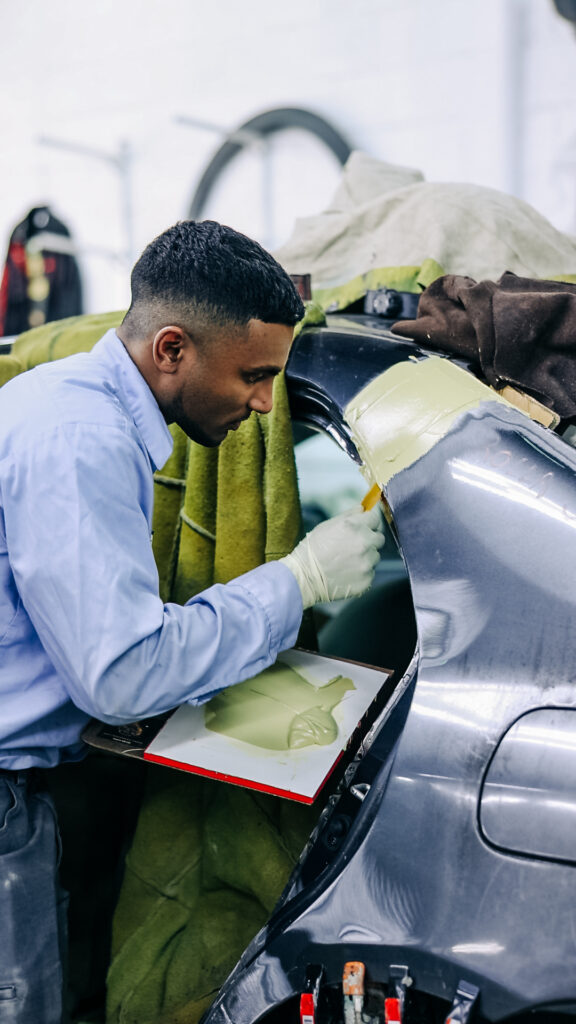
The process is more involved: the technician reshapes the metal, applies filler where needed, sands everything smooth, then primes, paints, and clear coats the panel, often blending color into neighboring panels so the repair disappears. Plastic bumper covers follow their own version of this process. Expect a panel level repair to take two to four days once parts and paint are in motion. Good shops photograph each stage of the work, so ask to see the process if you are curious what your panel went through.

When traditional body work is necessary, Quality Auto Body & Repair

Cost and time, compared honestly

For a comparable small dent, PDR might cost $150 while a conventional repair and respray of the same panel runs $400 to $1,000, mostly because of paint materials and added labor hours. Traditional repairs also mean days in the shop rather than hours, and a repainted panel, even a beautifully matched one, is no longer factory finish. When a dent sits near the line between methods, ask the estimator to price both routes, because seeing the numbers side by side usually settles it.

Hail is where the difference compounds. A roof and hood peppered with twenty small dents can often be fully restored with PDR for far less than repainting multiple panels, which is why insurers frequently prefer PDR on hail claims. Prices vary by vehicle and severity, so have the damage assessed in person before assuming either direction.

How insurance treats dent repairs

Dents from hail and falling objects fall under comprehensive coverage, while dents from collisions fall under collision coverage, each with its own deductible. Comprehensive claims are also generally treated differently than at fault accidents when policies renew, though every insurer handles its own rating decisions.

The deductible drives the decision for small dents. If your deductible is $500 and the PDR estimate is $250, filing a claim makes no sense: pay cash and move on. For widespread hail damage running into the thousands, a claim is usually the right move. An honest shop will price the repair first so you can decide with real numbers in hand. Bundling matters too: if one storm dents the hood and cracks the windshield, a single comprehensive claim can cover both under one deductible.

Bottom Line

Paintless dent repair is the fast, affordable, factory finish option for shallow dents with intact paint, and traditional body work is the right tool once paint damage, creases, or stretched metal enter the picture. The smart move is simply to have the dent evaluated before assuming the worst. Quality Auto Body offers both repair methods in Fairfax and will tell you straight which one your car actually needs. Stop by for an estimate and get the honest answer in minutes.

Related reading: What to Do After a Fender Bender in Fairfax, VA

What to Do After a Fender Bender in Fairfax, VA

Between Route 50, Little River Turnpike, and the daily crawl on Interstate 66, Fairfax drivers spend a lot of time inches from someone else’s bumper. Sooner or later a light changes, someone glances at a phone, and you feel that unmistakable thud.

A fender bender rattles you even at five miles per hour, and the decisions you make in the next hour shape how smoothly the claim and the repair go. Here is a calm, step by step playbook to keep in your glovebox.

What should you do immediately after a fender bender?

Check everyone for injuries first, move the vehicles out of traffic if they are drivable, and call 911 if anyone is hurt or the cars cannot move safely. Exchange names, phone numbers, insurance details, and license plate numbers, photograph everything before anyone leaves, and report the crash to your insurance company promptly.

In Virginia, crashes involving injury or significant damage should be reported to police, and even for minor damage a police report gives your claim a neutral record. On busy Fairfax roads, get out of live traffic lanes before you document anything.

What should you do immediately after a fender bender?, Quality Auto Body & Repair

Document the scene like an adjuster will read it

Photos win arguments later. Take wide shots showing both vehicles and their positions, then close ups of every damaged area, both license plates, and the other driver’s insurance card. Capture the surroundings too: skid marks, traffic signals, lane markings, and weather. Note the time and the exact location, such as Route 29 near Fairfax Circle. If the other driver seems agitated, stay polite and brief, and let the photos do the arguing later.

If anyone stopped to help, ask for a name and number, because a neutral witness is worth more than both drivers’ stories combined. Save any dashcam footage right away before it loops and records over itself. Two extra minutes of documentation can save weeks of claim friction. If police respond, note the officer’s name and the report number, since that report becomes the backbone of the claim.

Start the claim without hurting your own case

Notify your insurer promptly, even if the other driver was clearly at fault, and stick to plain facts: where, when, and what happened. Avoid speculating about fault at the scene or on recorded calls. Let the adjusters work from the photos, the police report, and the evidence rather than from anyone’s adrenaline fueled first impression. Virginia is an at fault state, so establishing cleanly what happened matters more here than in states where each policy simply covers its own car.

If the other driver caused the crash, their liability coverage should pay for your repairs with no deductible on your end. If you claim through your own collision coverage, your deductible applies, and your insurer may recover it for you later. For very minor damage, get a repair estimate first, since paying out of pocket occasionally makes more sense than filing a small claim. And if the other driver offers to settle in cash on the spot, decline politely, because roadside handshakes tend to evaporate once hidden damage appears.

Start the claim without hurting your own case, Quality Auto Body & Repair

You choose the body shop, not the insurance company

Virginia law puts the choice of repair shop in your hands. Your insurer can recommend shops from its direct repair network, and those recommendations often sound like instructions, but they cannot require you to use a particular shop. Your claim is just as valid at the licensed Fairfax shop you trust.

A quality shop will coordinate directly with any insurer, handle the estimate and supplement process, and document hidden damage properly. Pick the shop based on its work, its warranty, and its reputation, then let it manage the insurance back and forth. That is normal procedure, not a special favor.

Why a small hit still deserves a professional inspection

Modern bumpers are not just plastic and paint. They house parking sensors, radar modules, crash absorbers, and mounting brackets that can break invisibly while the outer cover pops back into shape. A bumper that looks barely scuffed can hide hundreds or even thousands of dollars in damage underneath. Trunk floors, radiator supports, and mounting points can shift in ways that only show up once a technician gets the car on a lift.

There is also your safety technology to consider. Cameras and sensors that power features like automatic emergency braking may need recalibration after even a light impact. A professional estimate is typically free, takes little time, and either buys you peace of mind or catches a real problem while the claim is still open instead of after it closes.

Bottom Line

After a fender bender in Fairfax, the order of operations is simple: safety first, document everything, report the crash, and remember that the repair shop choice is yours under Virginia law. Small collisions hide real damage often enough that a professional inspection is always worth the stop. Quality Auto Body has walked Fairfax drivers through this exact situation for years, and we are glad to look over the damage, write an honest estimate, and deal with the insurance company on your behalf. Come see us before you accept anyone’s shortcut.