
Frame Damage Explained: What Bent Structure Really Means
Few phrases land harder in a body shop office than frame damage. Most drivers hear it as a death sentence for the car, or at least for its value, and the folklore around it is thick: never buy one, never fix one, never trust one.
The reality is more precise and less scary. Modern structural repair is measured in millimeters, guided by manufacturer procedures, and done correctly every day. Here is what frame damage actually means on today’s cars, and how to think clearly if it happens to yours.
Can a car with frame damage be repaired?
Usually, yes. Most modern vehicles use a unibody structure that can be anchored to a computerized measuring bench, pulled back to factory specifications, or have damaged sections replaced entirely following manufacturer procedures. A proper structural repair restores the vehicle’s geometry and crash performance. Totaling the car makes more sense when damage is severe or repair costs approach the vehicle’s value.
The key word is proper. Structural work is where shop equipment and training matter most, and where the gap between a correct repair and a cosmetic one is widest.
Unibody, frame rails, and why crumpling is the design
Most trucks and some large SUVs still ride on a separate frame, but nearly every car and crossover on Fairfax roads is a unibody, meaning the body shell itself is the structure. That structure is deliberately uneven in strength: soft crush zones at the front and rear are engineered to fold and absorb energy in a crash, while ultra strong steel around the cabin refuses to deform and protects the people inside.
So a crumpled front structure is not a defect, it is the design doing its job, sacrificing metal to protect passengers. What matters afterward is whether the deformation stayed in the zones meant to crush, and that question cannot be answered by eye from the parking lot. It takes measurement.
How shops find and measure damage you cannot see
Clues show up first in the details: panel gaps that run uneven, doors that need a push to latch, a hood that sits slightly proud on one corner, a car that pulls or wears tires oddly after a crash. Any of those after a collision says the structure deserves a real look, even if the paint looks fine.
The real answer comes from a three dimensional measuring system. The vehicle is fixtured, and sensors or targets read dozens of factory reference points against the manufacturer’s specifications, revealing exactly which points sit out of tolerance and by how many millimeters. Factory tolerances are tight, generally within a few millimeters, and the printout becomes the map for the repair and the documentation for the insurer. No guesswork survives contact with a measuring bench.
What structural repair actually involves
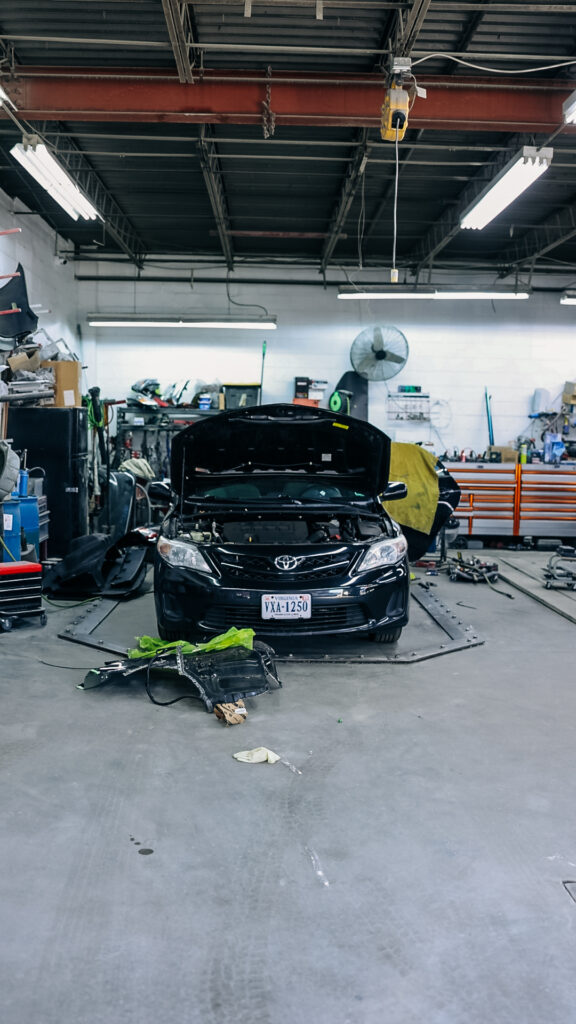
With the vehicle anchored, technicians use calibrated hydraulic equipment to pull the structure back toward specification, in a series of controlled, measured pulls rather than one dramatic yank, verifying against the data as they go. Where metal is kinked or beyond safe straightening, the damaged section is cut out at manufacturer specified locations and a new section is welded in following the exact factory procedure for that model.
Materials dictate methods. Many modern structures use high strength steels that must be replaced rather than straightened, because heating and pulling them compromises the engineered strength. Corrosion protection gets restored inside every repaired cavity, and the job finishes with a wheel alignment and ADAS calibration, since structural geometry is exactly what those sensor systems are aimed from. Done to this standard, the repair returns the car to its intended crash behavior.
Totals, titles, and what it means down the road
When structural repair costs climb toward the vehicle’s market value, the insurer totals it instead. Virginia’s threshold sits at roughly three quarters of the car’s value, so a major hit on an older vehicle often ends there, and honestly, that math protects you from pouring repair money into a car worth less than the bill.
If your car is repaired, keep every document: the measuring printouts, the parts list, the calibration reports. That file proves the quality of the work at resale, supports a diminished value claim, and answers any future buyer’s questions before they are asked. A structurally repaired car with documentation is a normal used car. One without documentation is a question mark, which is exactly the fate a good shop saves you from.
Bottom Line
Frame damage is a measurement problem, not a mystery, and modern shops solve it with benches, data, and factory procedures rather than folklore. The car is either restored to specification with proof, or the numbers say to walk away, and both outcomes protect you. Quality Auto Body performs measured structural repairs for Fairfax drivers, documents every step, and will tell you plainly when a car is not worth fixing. If someone has said the words frame damage to you this week, bring us the car and we will replace the fear with numbers.
Related reading: our frame structural repair services, Diminished Value Claims in Virginia: Money Most Drivers Miss, How Body Shops Match Paint on Modern Factory Finishes


